
Training for your team
Investment, not cost.
One senior who is happy and stays repays the training many times over. One project risk caught in time often does the same. Training for your team isn’t days away from client work. It’s deliberate risk management, and groundwork for the wins still ahead.
Why on-site
Same course, different outcome.
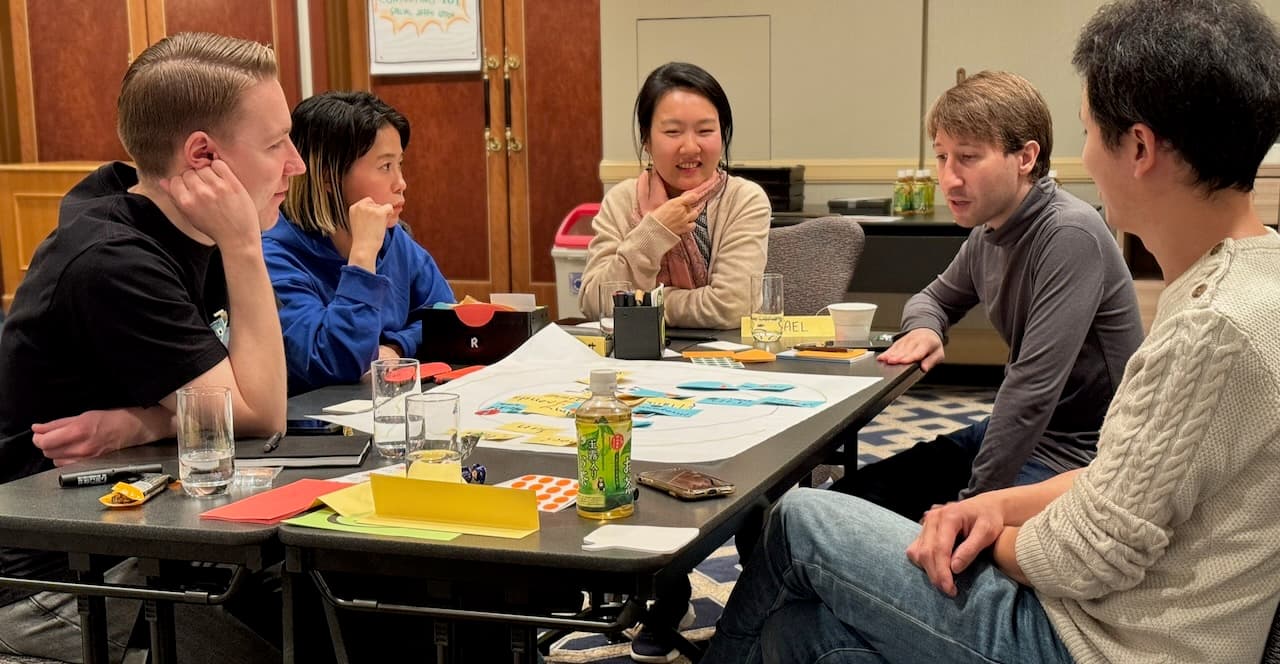
The public courses have their place: you learn Scrum or consulting skills properly, alongside professionals from other organisations. But when a whole team comes together with its own projects, the course day turns into a working day. The kind that has you doing things differently the next morning.
01
Your own projects in the room
People bring their real work situations into the room, not textbook examples. Two days away from the desk aren't days away from the work — they're the space to move forward exactly the things you're already wrestling with.
02
Things by their real names
When the room is only your own people, you can talk about what genuinely drags. On a public course it's “client X”. In your own course you name the project everyone recognises — and get to what it's actually about.
03
A shared language and method
When a team takes the same course together, a shared vocabulary and shared tools emerge. No fragments slowly assembled from different people's separate courses. The solutions stay in the team afterwards, because they were built together.
The maths of the investment
Would you rather avoid these?
When you weigh up the budget, compare the price of the course against what it prevents. The price depends on group size, content and length, but it stays well below any single one of the situations below the moment that one comes true.
One senior leaving
€50,000 – €200,000
Recruitment, onboarding, lost productivity and rebuilding client relationships. That's what it costs to replace one senior. Or that's what you save when they're happy and they stay.
Catching one risk in time
€10,000 – €100,000
A budget overrun, a lost client, or a fix made after the fact. One insight during the course is often enough for something like this to be spotted before it ever happens.
One longer client relationship
€100,000 – €500,000
When your consultant knows how to build trust, the client doesn't put the next engagement out to tender — they keep working with you. This is the core of The Power of Encounter.
None of these has to land during the course itself. It’s enough that you avoid one of them over the next year — and the odds of that go up once the team shares a language and sharper skills.
Start here
Humans and AI — one workshop, value right away.
A 1–2 hour interactive session that gives your team a structure for deciding when AI is worth reaching for in your own work. Affordable, easy to fit into the calendar, and a good way to see what Satori’s training feels like before a bigger commitment.
What you take away
- ·A decision framework: when AI accelerates the work, and when it dilutes it
- ·A shared vocabulary for what separates good and bad use of AI
- ·Concrete experiments you can start as early as next week
- ·Clarity on which of your own workflows to change and which to leave alone
Practical format
- ·1–2 hours live — depending on group size and goals
- ·Remote on Teams/Zoom, or in person at your premises
- ·Fits inside a team meeting, an all-hands or a kick-off
- ·Includes a short pre-survey so the session works on your situation specifically
The most affordable way to start with Satori
The price is a fraction of a full course day. At the same time you get a picture of how Teemu works before you decide on a bigger investment. Many clients book this workshop as part of a team day or to open a kick-off.
I’ll reply within a couple of days.
Most popular this year
The Power of Encounter — human skills in consulting and teamwork.
Your consultants know their craft. Even so, the client doesn’t always feel they’re getting what they pay for. Building trust, surfacing the real needs and moving forward through uncertainty decide whether the client stays with you or puts the next engagement out to tender. These skills don’t accumulate by accident on a project. They accumulate through practice.
What you learn
- ·Mapping stakeholders and building trust deliberately
- ·Digging out the client’s real needs
- ·Active listening and questioning technique
- ·Facing uncertainty and taking leadership in the moment
- ·The levels of consulting: extra pair of hands vs. trusted advisor
How you learn
- ·Experiential learning: insight, practice, reflection
- ·A realistic client simulation across two rounds
- ·Built on hundreds of real client situations
- ·A research-based learning structure (TBR + 4C)
- ·Immediate application to your own projects
Concrete results
For the consultant: awareness of their own effect on the client relationship, practical tools for every encounter, and confidence in unclear situations. · For the team: a shared language for the quality of consulting — one that juniors and seniors both recognise. · For the company: longer client relationships, more clients who recommend you, and a clearer gap to the competition.
What the delivery includes
A planning call and tailoring to the team’s needs, a 2-day delivery on your own examples, analysis of the pre-work and the materials, all of the trainer’s costs, plus a reflection call and feedback analysis afterwards.
The exact content, length and price are agreed in the discovery call. The scope of the session is set by the number of participants, the areas you want to go deeper on, and any follow-up sessions.
I’ll reply within a couple of days.
Proof of results
The numbers from the two most recent Power of Encounter deliveries.
35 participants in total. The rating average is collected from the Scrum Alliance courses Teemu has run since 2018.
9.2 / 10
Value to me personally
9.8 / 10
Trainer rating
83 %
Net Promoter Score (NPS)
4.90 / 5
Scrum Alliance course ratings (131)
“What I liked most was how all the practice situations played out. They were fast and unpredictable, which left no room to get anxious about the task beforehand.”
Repertoire
What else can be built.
On top of what’s already highlighted above, these can be built too. Every course is delivered on-site and tailored, and the tailoring is part of the work, not an extra charge. Missing something from the list? Ask.
CSM® · CSPO® · A-CSM® on-site
Scrum Alliance certification for your team
The same certified courses as the public ones, built around your team. Content is matched to your domain, your team's maturity and your situation. The credential is still the official Scrum Alliance certification.
TBR for trainers
Training from the Back of the Room
For your internal trainers and facilitators: how to design training so the learning stays alive instead of fading in two weeks. Built on the science of learning, not the trainer's intuition.
Facilitation and workshops
Strategy days, retrospectives, decisions
A single day or a series of sessions where an outside facilitator moves the work forward and holds the room together. Practical tools for group decisions and difficult conversations.
Event design and delivery
Conferences, kick-offs, all-hands
A large event where hundreds of people need to be genuinely involved: script, facilitation, trainers and programme, all built around your goals.
How it goes
Four steps from discovery to reflection call.
1
Discovery call
30 minutes, no obligation. We go through your situation and where you want the course to focus.
2
Pre-work and tailoring
Participants fill in a short pre-course survey. Based on it I tailor the programme to your situation and we settle the practical details.
3
The course (usually 2 days)
At your premises or an agreed venue. Intensive and built on your own examples — no slide marathon.
4
Reflection call
A couple of weeks after the course. We go through what has stayed alive and what's still worth reinforcing.
Next step
Let’s set up a discovery call.
30 minutes, no obligation. Tell me about your situation and where you want the course to focus. I’ll come back with a proposal within a couple of days.
teemu@satorikoulutuspalvelut.fi · LinkedIn: /in/teemuhoo